Σάββατο 13 Ιουνίου 2026 στις 18.30

Μικροφωνική ενάντια στα Κέντρα Κράτησης μεταναστ/ρι/ών/@
Nea Ionia metro station 13/6, 18:30
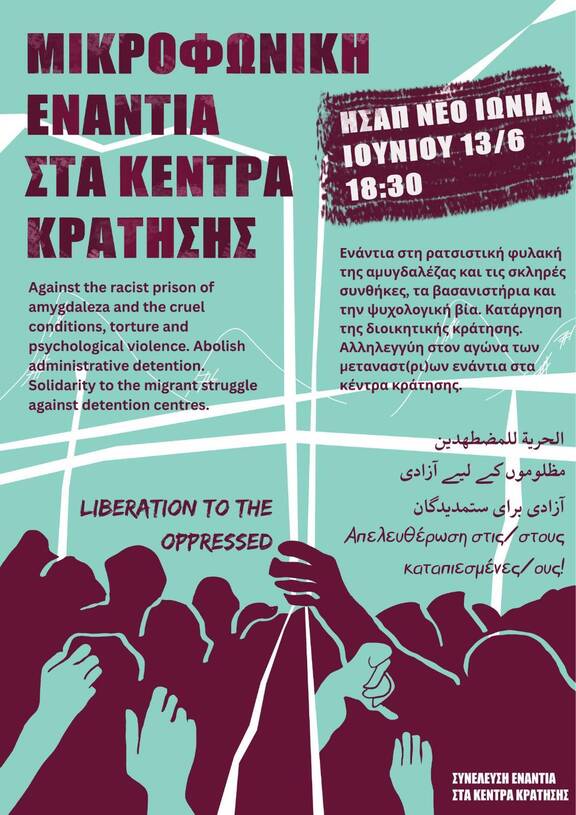
Rally/Microphone against the immigration detention prison/@ Amygdaleza in Menidi and for the abolition of all prisons and detention centers!
We are gathering at the Nea Ionia metro station, where many people pass by to visit friends and relatives in the Amygdaleza hell, in order to spread the movement against detention centers to neighborhoods closer to the prison.
Amygdaleza is part of a parallel prison-detention center structure where people are imprisoned due to administrative (police) decisions for not possessing approved state documents. In Amygdaleza, approximately 900 men and 40 women from countries such as Egypt, Pakistan, Albania and Georgia are subjected to the worst possible conditions, designed to exhaust and oppress. The overcrowded, unsanitary and rotten structures are not only physical and psychological punishment, but also deliberate conditions designed to push people to seek deportation rather than suffer such torture.
In Amygdaleza, people are isolated from the city and support networks, with limited opportunities to connect with the outside world and nothing to do with their time. Many people come to Amygdaleza directly from the border - traumatized by shipwrecks and police violence - and enter the prison in a state of confusion, without clear information about why they are there, how long they will be there, and without support to seek asylum. Others are picked up from the streets of Athens, on public transport or while wandering in public spaces. Some have worked and lived in Greece for years. In Amygdaleza, they are at a dead end, and only those lucky enough to have existing support networks in the city can access lawyers and basic things like clothes, soap and SIM cards through visits from friends, who have to travel 1.5 hours by bus from Athens to get there. Violent police repression, the sale of tranquilizers by police officers openly or secretly administering them through food, and solitary confinement are all common practices for subjugating and controlling the prison population.
Detention centers are inherently exclusionary tools for enforcing racist borders and are used by states all over the world. The detention center is the result of a process of criminalization: the state creates the "crime" of so-called irregular movement, that is, movement without papers, and then imprisons those who claim their right to free movement. Because movement itself is human and non-aggressive, the state must create the figure of the threatening "other" to justify the existence of the detention center and the horrific, punitive conditions there. This threatening "other" inside the detention center is the young, single, racialized man (often Muslim) who is a "threat" to public safety and the fiction of national "values" or "civilization." The torturous conditions of detention centers, apart from deportations, pushbacks and fear in the streets, are the only real violence and it comes from the state. The racist anti-immigrant narrative, which has spread to the point of banal normalization, must be met with resistance because it supports the justification of racist borders and maintains the structural system of exploitation.
Το Σεπτέμβριο του 2025, η Ελλάδα ψήφισε ένα νέο αντιμεταναστευτικό νόμο, ο οποίος κατοχυρώνει τη ρατσιστική φράση «παράνομη μετανάστευση». Μεταξύ άλλων, αυτός ο νέος νόμος αυξάνει τη μέγιστη διάρκεια κράτησης σε 2 χρόνια και καθιστά την παραμονή στην Ελλάδα χωρίς έγγραφα ποινικό αδίκημα που τιμωρείται με έως και 5 χρόνια στις φυλακές. Έχουμε γίνει μάρτυρες του χάους, που έχει δημιουργήσει αυτός ο νόμος, μαζικών δικών με δικαστές που αγνοούν το νέο νόμο αλλά εξακολουθούν να εκδίδουν τυχαίες καταδίκες, παντελούς έλλειψης μεταφραστών που συνεχίζουν την πολυετή απεργία τους λόγω χαμηλότερου του κατώτατου μισθού και ατόμων που εκπροσωπούν τους εαυτ/ές/ούς/@ τους λόγω παντελούς έλλειψης νομικής υποστήριξης.
Το υπερφορτωμένο, διεφθαρμένο και ρατσιστικό νομικό σύστημα είναι ανίκανο να διαχειριστεί το νέο αντιμεταναστευτικό νόμο, και αυτό ακριβώς είναι το θέμα. Όπως αποδεικνύουν οι δίκες που καταδικάζουν άτομα για λαθρεμπόριο - οι οποίες έχουν μέση διάρκεια 5 λεπτά η καθεμία - το νομικό σύστημα θα δημιουργήσει μια μεγάλη αύξηση του πληθυσμού των ήδη υπερπλήρων φυλακών (όπου σήμερα το 1/3 των κρατουμένων προέρχεται από μεταναστευτικό υπόβαθρο) και των κέντρων κράτησης. Μια τέτοια επέκταση θα δημιουργήσει κέρδος μέσω κατασκευών και συμβάσεων και μέσω της εκμετάλλευσης της εργασίας στις αγροτικές φυλακές, αλλά εξίσου σημαντικό είναι ότι θα εδραιώσει ένα φυλετικοποιημένο κοινωνικό και πολιτικό σύστημα, στο οποίο ο φόβος, η καταπίεση και ο νόμος συνδυάζονται για να δημιουργήσουν μια εκμεταλλεύσιμη τάξη προς όφελος ενός εθνοτικού-εθνικιστικού κράτους. Ακόμη και πριν από το νέο νόμο, τα συστήματα των ποινικών φυλακών και των κέντρων κράτησης ήταν διασυνδεδεμένα, για παράδειγμα μέσω της συνήθους πρακτικής της μεταφοράς ατόμων, που έχουν εκτίσει την ποινή τους αλλά δεν έχουν χαρτιά ή υποβάλλουν αίτηση ασύλου, σε κέντρα κράτησης, παρατείνοντας αυθαίρετα τη φυλάκιση και την τιμωρία τους.
Άνθρωποι πεθαίνουν τακτικά σε κέντρα κράτησης μεταναστών όπως η Αμυγδαλέζα - καθώς και σε αστυνομικά τμήματα, όπου δεν υπάρχει σχεδόν καθόλου ιατρική περίθαλψη - λόγω της έλλειψης ιατρικού προσωπικού, εξοπλισμού και της αδιαφορίας και των ρατσιστικών συμπεριφορών της αστυνομίας. Οι πραγματικοί αριθμοί δεν αναφέρονται, αλλά ακούμε σχεδόν σε εβδομαδιαία βάση για περιστατικά αυτοτραυματισμού, απόπειρας αυτοκτονίας, αυτοκτονίας και θανάτων λόγω παραμέλησης. Αυτά είναι και τα δύο απολύτως αποτρέψιμα και μέρος της εγγενούς βίας του συστήματος που καταστέλλει τους κρατούμενους μέσω συστηματικής παραμέλησης των σωματικών και ψυχικών τους αναγκών υγείας, οδηγώντας στην ανάπτυξη προβλημάτων υγείας που απορρέουν άμεσα από τις συνθήκες κράτησης ή, στις χειρότερες περιπτώσεις, στην απώλεια ζωής. Ακούμε τρομερές αναφορές για την έλλειψη φροντίδας και σεβασμού για τη μεταχείριση των νεκρών. Συχνά αυτά τα περιστατικά οδηγούν σε μαζικές διαμαρτυρίες στα κέντρα από κρατούμενους που βλέπουν πόσο λίγο εκτιμά το κράτος τη ζωή τους.
Στις 14 Ιουνίου συμπληρώνονται 3 χρόνια από τη σφαγή του κράτους στην Πύλο, στην οποία πάνω από 650 άνθρωποι πνίγηκαν λόγω των ενεργειών του Ελληνικού Λιμενικού Σώματος και 9 άτομα κατηγορήθηκαν άδικα ότι οδηγούσαν το σκάφος και στάλθηκαν στη φυλακή. Οι επαναπροωθήσεις στα σύνορα και η ποινικοποίηση μέσω ψευδών κατηγοριών για λεγόμενο λαθρεμπόριο έχουν γίνει συνηθισμένη πρακτική. Εντός της χώρας, τα σύνορα επεκτείνονται στη ζωή των μεταναστών μέσω περιορισμών στην πρόσβαση στην υγεία, την εκπαίδευση, τη στέγαση και την εργασία. Ένα από τα μεγαλύτερα προβλήματα που αντιμετωπίζουν τα άτομα είναι η συνεχής απειλή φυλάκισης σε κέντρα κράτησης για μήνες και χρόνια απλά και μόνο επειδή δεν έχουν τα «σωστά» έγγραφα.
Για ένα κόσμο χωρίς χαρτιά στον οποίο κάθε κλουβί θα έχει καεί!
Αλληλεγγύη στην Παλαιστίνη και ενάντια στο νέο δολοφονικό νόμο!
Αλληλεγγύη σε όλους τους πολιτικούς κρατούμενους!
Κάλεσμα σε διαδήλωση για να θυμηθούμε τις μαζικές κρατικές δολοφονίες στην Πύλο και τη Χίο:
14/6 Πλατεία Ομονοίας 6.30
Mikrofoniki against migrant detention centres
Nea Ionia metro station 13/6, 18:30
Gathering/Mikrofoniki against the Amygdaleza migrant detention prison in Mendi and for the abolition of all prisons and detention centres!
We gather at Nea Ionia metro station where many people pass through to visit their friends and family in the hellhole of Amygdaleza to spread the movement against detention centres to neighbourhoods closer to the prison.
Amygdaleza is part of the parallel prison structure - detention centres which incarcerate people due to administrative (police) decisions for not having state-sanctioned documents. In Amygdaleza, around 900 men and 40 women from countries including Egypt, Pakistan, Albania and Georgia are subjected to the worst possible conditions, designed to exhaust and oppress. The overcrowded, unhygienic and rotting structures are not only physical and psychological punishment but intentional conditions designed to push people into self-deportation rather than suffer such torture.
In Amygdaleza people are isolated from the city and support networks, with limited possibilities to connect with the outside world and nothing to pass the time. Many people come to Amygdaleza straight from the borders - traumatised from shipwrecks and police violence - and enter the prison in a state of confusion, without clear information about why they are there, how long they will stay inside and without support to claim asylum. Others are taken from the streets of Athens, on public transport or while hanging out in public spaces; some have been working and living for years in Greece. In Amygdaleza they find themselves in limbo, and only those lucky enough to have existing support networks in the city can access lawyers and basic things like clothes, soap and SIM cards through visits from friends, who have to travel 1.5 hours by bus from Athens to reach them. Violent police repression, cops selling sedatives openly or covertly administering them through food, and solitary confinement are all common practices to subdue and control the prison population.
Detention centres are inherently exclusionary tools to enforce racist borders and are used by states across the world. The detention centre is a result of the process of criminalisation: the state creates the 'crime' of so-called irregular movement, i.e. movement without papers, and then imprisons those who assert their right to free mobility. Because movement in itself is human and non-aggressive, the state must create the figure of the threatening 'other' in order to justify the existence of the detention centre and the horrific, punitive conditions inside. This 'other' inside the detention centre is the young, single, racialised man (often Muslim) who represents a 'threat' to public security and the fiction of national 'values' or 'culture'. The torturous conditions of detention centres in addition to deportations, pushbacks and fear on the streets is the only real violence and it comes from the state. The racist anti-migration narrative which has spread to the point of banal normalisation must be resisted because it underpins the justification of racist borders, and because it maintains the structural system of exploitation.
In September 2025, Greece passed a new anti-migration law, which enshrines into law the racist phrase 'illegal migration'. Among other things this new law increases maximum detention time to 2 years and makes remaining in Greece without documents a criminal offence punishable by up to 5 years in mainstream prison. We have witnessed the chaos inside Evelpidon that this law has created, mass trials with judges ignorant of the new law but still making random convictions, a total lack of translators who continue their years long strike due to below minimum wage pay and individuals representing themselves due to a total lack of legal support.
The overwhelmed, corrupt and racist legal system is incapable of accommodating the new anti-migration law, and that is exactly the point. Just as the trials that convict individuals for smuggling - which have an average length of 5 minutes each - prove, the legal system will create a big expansion in the populations of already overcrowded mainstream prisons (where currently 1/3 of prisoners are from a migrant background) and detention centres. Such an expansion will create profit through construction and contracts and through exploited labour in agricultural prisons but just as importantly it will solidify a racialised social and political system it which fear, oppression and the law combine to create an exploitable class for the benefit of an ethno-nationalist state. Even before the new law, the criminal prison and detention centre systems were interconnected, for instance through the standard practice of transferring people who have finished a criminal sentence but are without papers or applying for asylum to detention centres, arbitrarily extending their imprisonment and punishment.
People regularly die in migrant detention centers such as Amygdaleza - as well as police stations where there are no doctors at all - due to the lack of medical staff, equipment and the indifference and racist attitudes of the police. The true numbers are not reported but we hear on an almost weekly basis about incidents of self-harm, attempted suicide, suicide and deaths due to neglect. These are both totally preventable and part of the inherent violence of the system which suppresses prisoners through systemic neglect of their physical and mental health needs, leading to the development of health conditions stemming directly from the conditions of detention or in the worst cases loss of life. We hear terrible reports of the lack of care and respect for the treatment of dead bodies. Often these incidents lead to mass protests in the centers from prisoners who see how little the state values their lives.
14th June marks 3 years since the state massacre at Pylos in which over 650 people drowned due to the actions of the Greek Coast Guard and 9 people were wrongfully accused of driving the boat and sent to prison. Pushbacks on the border and criminalization through false accusations of so-called smuggling have become common practice. Inside the country, borders extend into migrant's lives through limitations on access to health, education, housing and work. One of the biggest facing individuals is the constant threat of imprisonment in detention centers for months and years simply for not having the 'correct' papers.
For a World Without Papers in which Every Cage has Burned!
Solidarity to Palestine and against the new murderous law
Solidarity to all political prisoners
Call for demo to remember the mass state murders of Pylos and Chios: 14/6 Ommonia Square 6.30
πηγή : email που λάβαμε στις 7 Ιουνίου 12h